EmuRV
Rust · Tauri 2 · Unicorn Engine · RV32IMAFDC / RV64IM
EmuRV is a desktop environment for learning RISC-V assembly: write, assemble, run or step, and watch the registers and memory change. It exists to replace emu8086 in a computer engineering degree, and its error messages are written in the student's own language. The interesting part isn't the interface — it's that a teaching tool was held to the correctness standard of a production emulator: the official RISC-V suites and the formal golden model of the specification.
Sole author: the Rust core, the assembler, the emulated devices, the CLI, the GDB stub, the frontend and the test suites. Built with AI assistance under one rule — every decision is recorded with its why, and nothing lands without me reviewing it. FIUNI, Computer Engineering.
01The 8086 in the room
In the Microprocessors course you learn assembly on emu8086: a 16-bit Intel 8086 emulator, Windows-only, from the DOS era. It does the job — until you try to write something that reacts to a keypress while it runs. My own experience with that wall is where this thesis starts.
RISC-V is the obvious replacement: an open specification, current, and the one the industry is actually adopting. But the RISC-V tools built for teaching are aging or closed — RARS is Java, Ripes is Qt, CPUlator is a closed web app. None of them is a modern native desktop application with real-time I/O. That gap is the whole reason EmuRV exists.
02Try it right here
Below is a working EmuRV, running in your browser. It is not a video and not a mockup: press Ensamblar, then Paso, and watch the registers light up as they change. Click the editor's left margin to drop a breakpoint. Run «Suma interactiva» and type into the console when it asks, or open the «Sprites» tab to watch the 320×240 screen get drawn. Switch the theme, open the lessons, read the help.
Honest about what this is: a faithful in-browser reconstruction of the interface, with a JavaScript interpreter underneath that genuinely assembles and executes the three programs on the tabs — here the editor is read-only, and the rest of the catalogue is labelled «solo en la app». The desktop application runs on Unicorn Engine with the full RV32IMAFDC repertoire, your own programs, ELF import and export, a GDB stub and detachable windows. Everything on the sheets that follow describes the real one.
The demo needs a window at least 1000 px wide to fit the editor and the panels side by side. On a narrow screen it will say so — open it full screen, or come back from a laptop.
03What happens when you press Step
A Tauri 2 shell, a Rust core, and the CPU itself borrowed from Unicorn Engine — the emulation engine carved out of QEMU. The emulation lives in its own thread and never talks to the UI directly: the interface sends commands and receives events (paused, output, registers_update). Between the two sits the piece everything else depends on.
The source_map, first
Assembling doesn't just produce bytes: it produces a bidirectional table between source line and address. Every 32-bit word emitted knows which line it came from — including the ones expanded out of a pseudo-instruction — and every line knows its first word. That table is what lets a click on the editor's margin become a real breakpoint, and what highlights the line that is about to execute. It had to be designed first, because everything else hangs off it.
The bug that shaped the execution loop
The first version called Unicorn once and let it run to the end, with a timeout to interrupt it. Then a student program of the form loop: j loop left the «Stop» button dead: Unicorn's timeout does not cut a tight loop with no syscalls in it. The instruction count does cut it, so execution was rewritten into bounded slices, checking for the stop signal between them.
A fixed slice of one million instructions cost speed. The current version makes the slice adaptive: it aims at roughly 40 ms of wall time per check, and drops back to the floor when the graphics screen is on, so frames keep their cadence. That single change moved the engine from 129–309 to 160–718 M instructions per second without losing any perceptible responsiveness. The register refresh was decoupled too — emitting one event per slice would have been about 500 events a second at the UI.
04The assembler I did not plan to write
The thesis brief closed the stack up front, and it said Keystone for assembly. Keystone's RISC-V support turned out not to be incomplete — it is nonexistent. I checked the 0.9.2 headers directly: the ks_arch enum has no KS_ARCH_RISCV entry at all, in any official release. That is a risk that fires on day one of a project, and the plan B was to write the assembler myself.
Which turned out to be the better outcome anyway, for two reasons the brief could not have anticipated: total control of the source_map, and diagnostics written for a beginner rather than for a toolchain. A third-party assembler would have handed me an English error with a byte offset.
hola.s: línea 7, columna 9: instrucción desconocida: «sumar». EmuRV soporta RV32IM
        (enteros y multiplicación/división de 32 bits) y Zicsr (csrr/csrw/…)
hola.s: línea 12, columna 14: «li» carga constantes numéricas; para direcciones
        de etiquetas usá «la»
emurv-cli: el ensamblado falló con 2 error(es)
Real output, not an illustration. Every diagnostic carries line, column and — where the mistake has a common cause — the fix. In the app the same errors appear underlined in the editor.
How I know the encodings are right
An assembler that emits a wrong word produces a program that runs and gives the wrong answer — the worst possible failure for a teaching tool. So the encodings are not checked by hand: an oracle test suite assembles the same source with GNU as and compares the emitted words one by one. That oracle covers floating point (F and D), the atomics (A), the compressed 2-byte instructions (C) and the RV64IM repertoire against as -march=rv64im.
- 001Full repertoire, switchable widthRV32IMAFDC — integers, multiply/divide, single and double floating point with the
f0–f31file, atomics, and hand-written compressed instructions. A selector in the toolbar switches the machine to RV64:ld/sd,lwu, the «W» instructions and 6-bit shift amounts. RV32 stays untouched, and a 64-bit instruction inside an RV32 program produces a teaching error rather than a wrong result. - 002Directives a real project needs
.includeresolved relative to the including file,.macrowith named parameters,.eqv/.equconstants, and%hi()/%lo()so a student can see whatlaactually expands to. Multi-file programs work in the app and from the CLI. - 003Standard ELF32, in and outExport produces a real ELF32 RISC-V that other tools load — Ripes,
objdump. Import is the other direction: open a binary and the editor switches to read-only disassembly mode, with run, step and breakpoints working on the listing. A C program compiled withriscv64-elf-gccloads too; an ELF with the wrong base address is rejected with a message that names the exact flag that is missing. - 004A relocatable variant, because someone will ask
asm --reubicableemits symbol references PC-relative (auipc) instead of absolute and marks the ELFET_DYN, for a loader that places it somewhere else. The default stays absolute: that is the one that matches EmuRV's memory map when you inspect it elsewhere.
05Devices, and the game that justifies them
The whole memory map is compatible with RARS — the same base addresses, the same keyboard semantics. That is not nostalgia: it means the Spanish-language teaching material that already exists for RARS runs on EmuRV unchanged.
sbrk (syscall 9). No free.Polling, and why it isn't a shortcut
All the I/O is polling, and that is a documented structural limitation, not a simplification: Unicorn's own FAQ states that it does not expose hardware interrupts. Building a CLINT and a PLIC on top of a CPU-only engine that officially does not support them is real architecture work, and it is written down as future work rather than quietly implied. What does exist is a keyboard the program can poll without ever blocking, plus syscalls 30 (system time in ms) and 32 (sleep, interruptible by «Stop»).
The .text region being read-only is a deliberate teaching policy — W^X. Jumping into data or patching your own code stops with a message that explains what happened rather than corrupting silently. Keep that decision in mind: it comes back with a cost on the next sheet.
Tetris as an acceptance test
The example that closes the lesson series is a port to RV32IM of an 8086 Tetris from the same Microprocessors course — the exact program that was painful on emu8086. Board in memory, bitmaps, collisions, line clears, scoring, drawn as coloured blocks on the 320×240 screen and played with the keyboard. Its game logic and the resulting pixels are checked by a test oracle, not by me looking at it.
06Two verdicts I did not write myself
My own tests can only tell me the emulator agrees with what I believed when I wrote it. So the correctness argument rests on two suites that come from outside the project: the official riscv-tests, and riscv-arch-test through RISCOF, which compares my machine's output against Sail — the formal golden model of RISC-V International. Every number below is reproducible from a script in the repository.
The four exclusions and the two mismatches, named
A result with an asterisk is worth nothing if the asterisk is not spelled out, so here they are, each traced to root cause rather than waved away.
.text and jump into data — self-modifying code is precisely what they are testing. The official environment links everything into one RWX segment. EmuRV maps .text read-only by the teaching decision on the previous sheet, and stops with «the program tried to write to an address that doesn't belong to .data». Incompatible by design; the compressed decoding itself is covered by my own oracle against GNU as.
ebreak belongs to the debugger
The test expects c.ebreak to be delegated to the guest's trap handler. In EmuRV ebreak is the software breakpoint mechanism of the UI, so it never reaches the guest. Same shape of conflict: a deliberate decision, not a semantics defect.
fmax.s(1.0, sNaN) returning a canonical qNaN instead of 1.0. That is the IEEE 754-2008 semantics, superseded by the RISC-V F v2.2 spec: QEMU fixed it in 6.0, but Unicorn 2.x is still based on QEMU 5.0.1. Subtest 20 of fmin.S detects exactly that case. Documented as an inherited limitation — with the version chain that explains it.
And underneath, the ordinary discipline
07Measured against the reference, not against itself
Four RV32IM kernels, the same algorithm on four emulators, ~500 M instructions per run, median of five, and equivalence verified first — all four produce the same numeric result per kernel. Comparing an emulator only against its own previous version proves nothing.
Millions of instructions per second, median of 5. EmuRV 0.1.0 (Unicorn 2.1.5) · QEMU 11.0.2 · Spike 1.1.1-dev · RARS 1.6 on OpenJDK 25, with its 0.133 s JVM startup discounted.
Reading it honestly
Against RARS — its actual category, the same didactic job — EmuRV is 28 to 120× faster. Against Spike, the reference instruction-set simulator of the ecosystem, it lands in the same order of magnitude: 81 % of Spike on pure ALU. Against plain QEMU it is 0.7 to 1.5 orders behind.
That remaining gap is bought, not lost: an interruptibility check every ~40 ms, the observation hooks that make the keyboard, the screen and the syscalls visible, and a wall time that includes process start and assembling the source. The engine's own ceiling with no slicing, on the same machine, was 1 293 M instr/s when it was last remeasured. The requirement in the spec was 10 — it clears it by 16 to 72× in the worst kernel, and the author's decision was to stop chasing speed there.
Limitations I am declaring before you find them
- 001Nominal instruction countDeterministic loops counted over the listing, not retired by a hardware counter. The same criterion is applied to all four emulators, so the ratios hold even if an absolute is off.
- 002Synthetic microkernels, not CoreMarkThe bare-metal CoreMark port per target was deferred by an explicit effort gate. It does not change the order-of-magnitude conclusion, and the harness is ready for it.
- 003One machine, and QEMU in system modeEverything ran on a single Apple M4 Pro, so the ratios between emulators are the citable part, not the absolutes. QEMU had to run in system mode because macOS Homebrew ships no user-mode build; Spike and QEMU execute bare-metal ELF while EmuRV and RARS execute the same assembly source.
- 004emu8086 is a documentary comparisonThe emulator EmuRV replaces is a step-by-step interpreter that redraws its UI per instruction, publishes no performance figures, and needs a Windows machine to run. I am not going to invent a number for it.
08The part the student actually touches
Everything themeable lives in CSS design tokens, so a theme is one block of variable overrides and no duplicated CSS. Five themes ship with the app plus one the user builds, and the contrast of all five is verified by an automated test — body text and editor syntax both, against WCAG AA. A theme that fails the test does not ship.
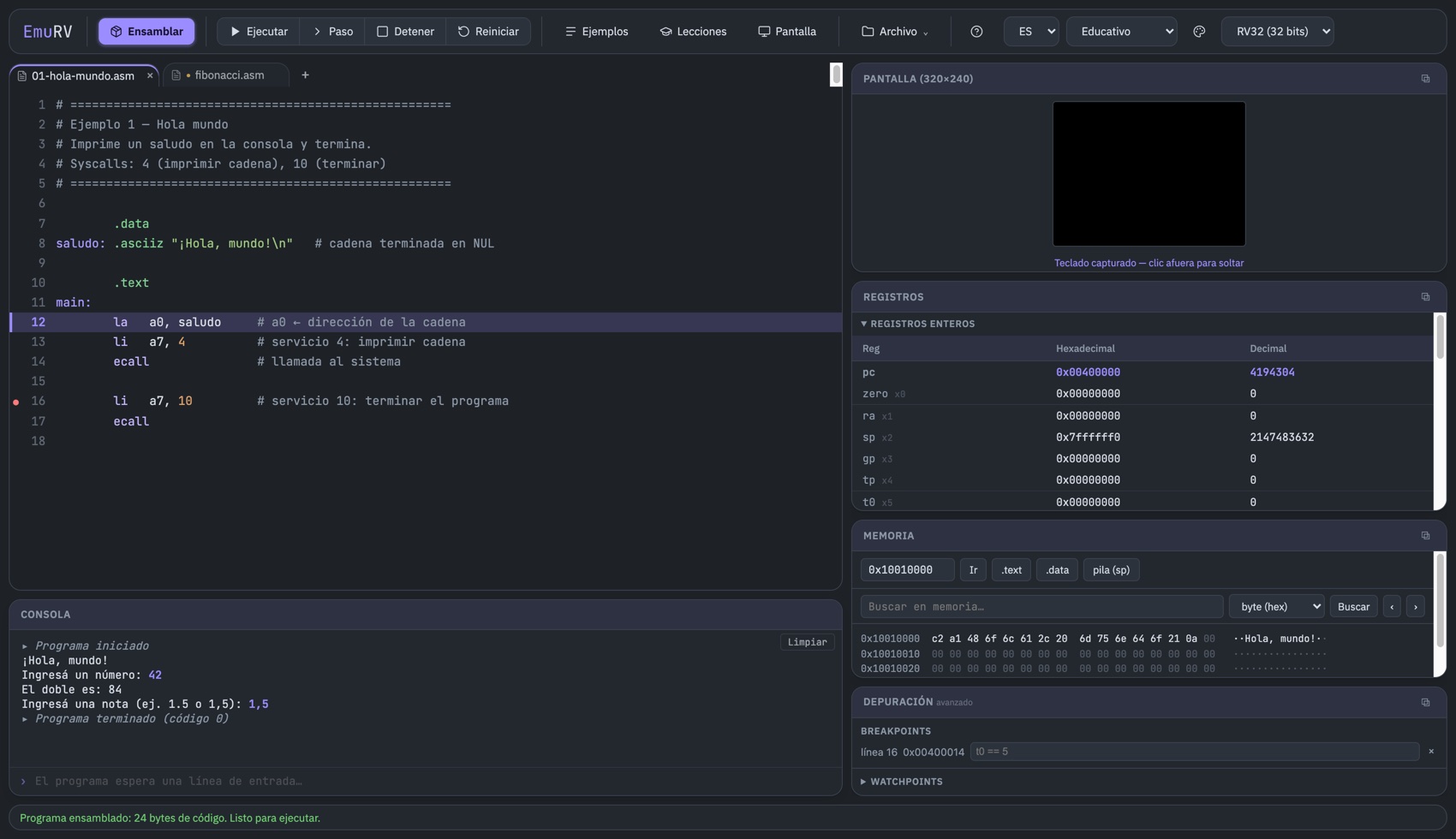
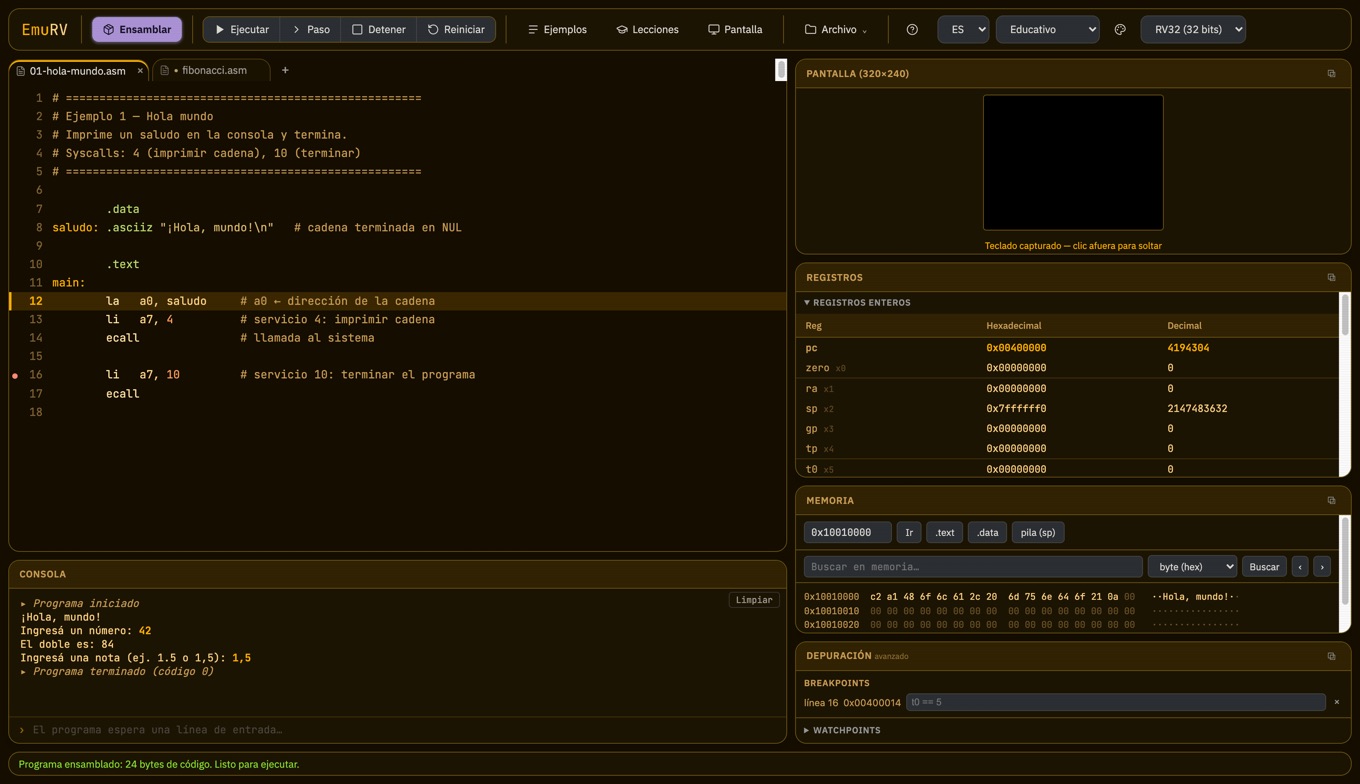
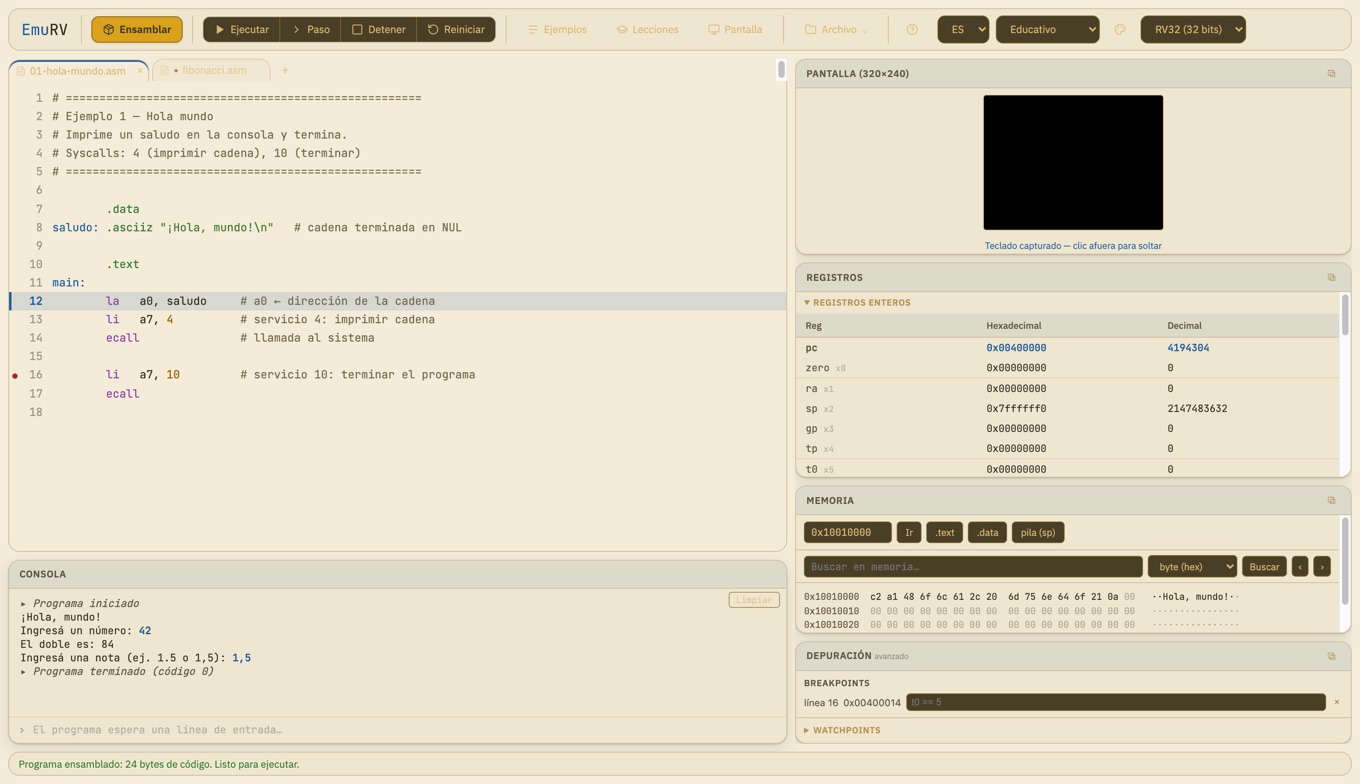
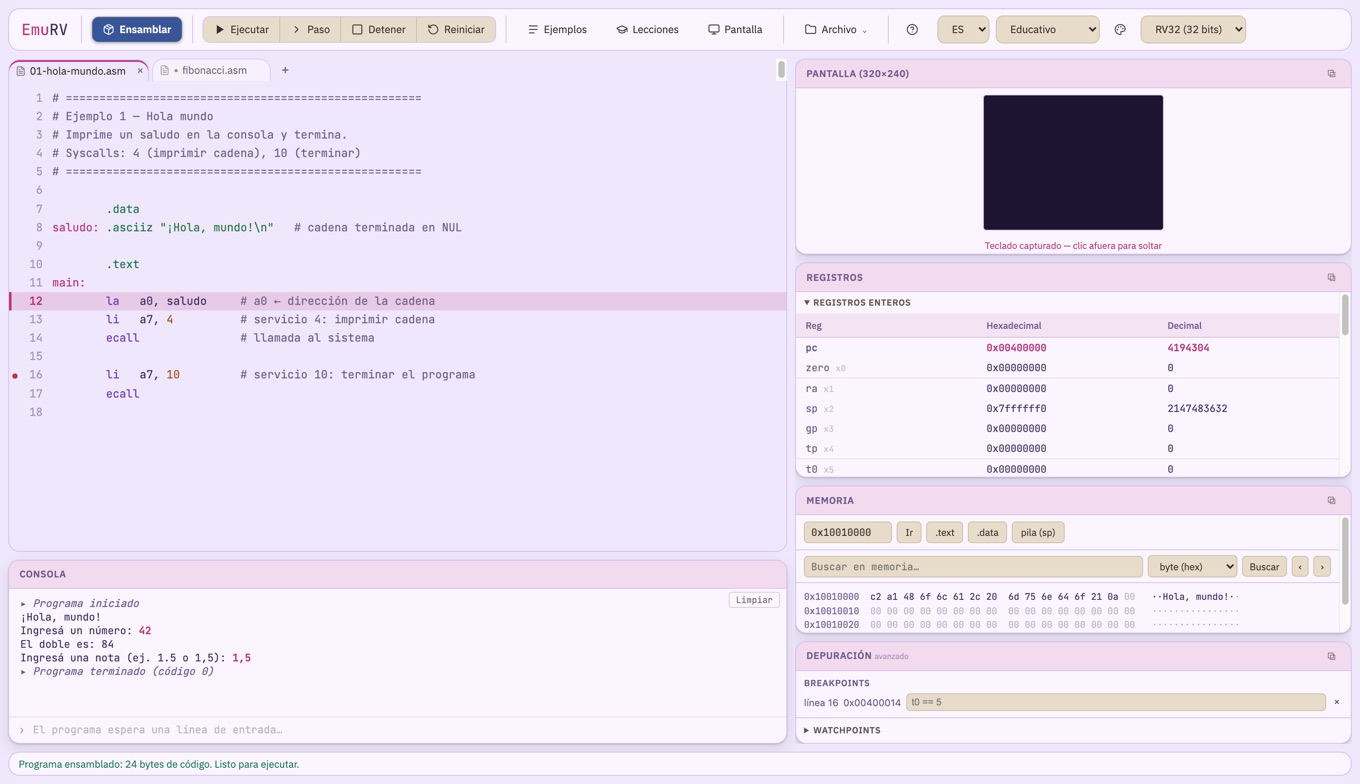
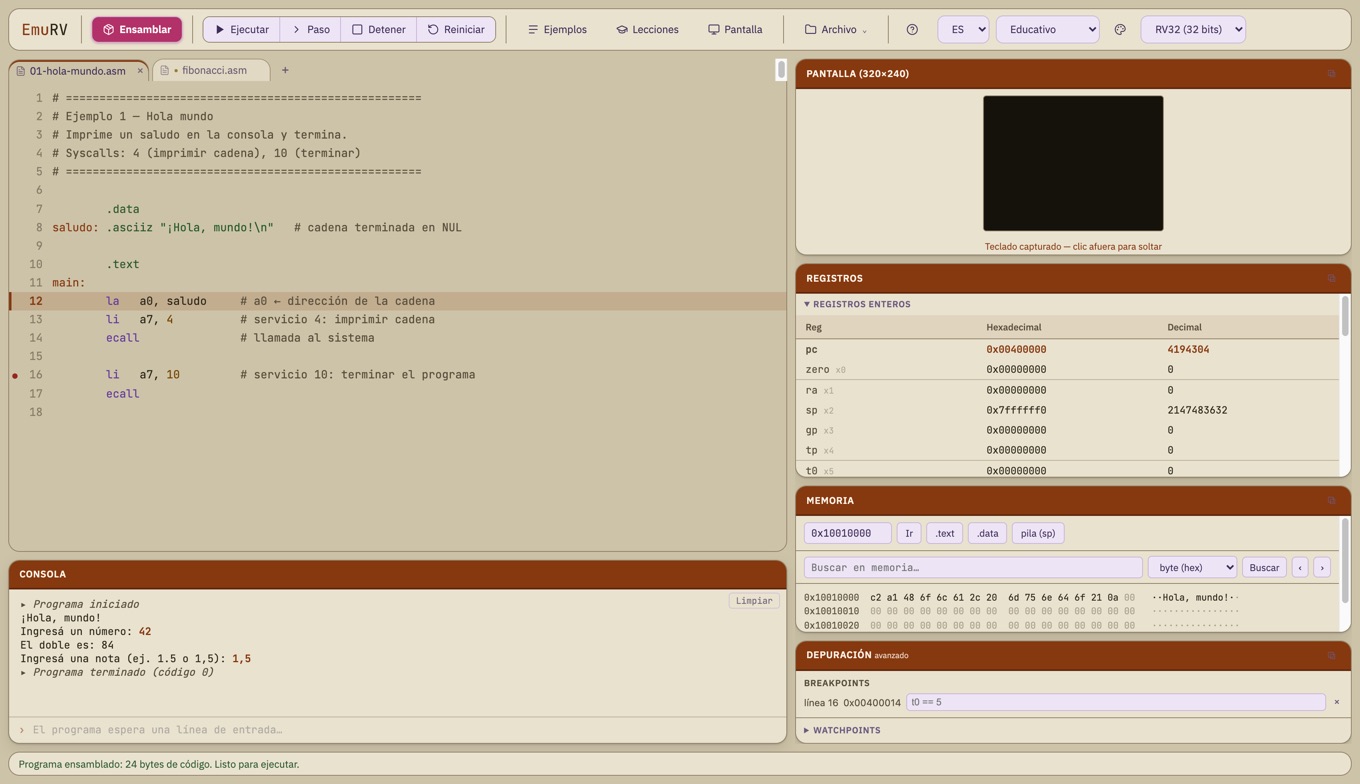
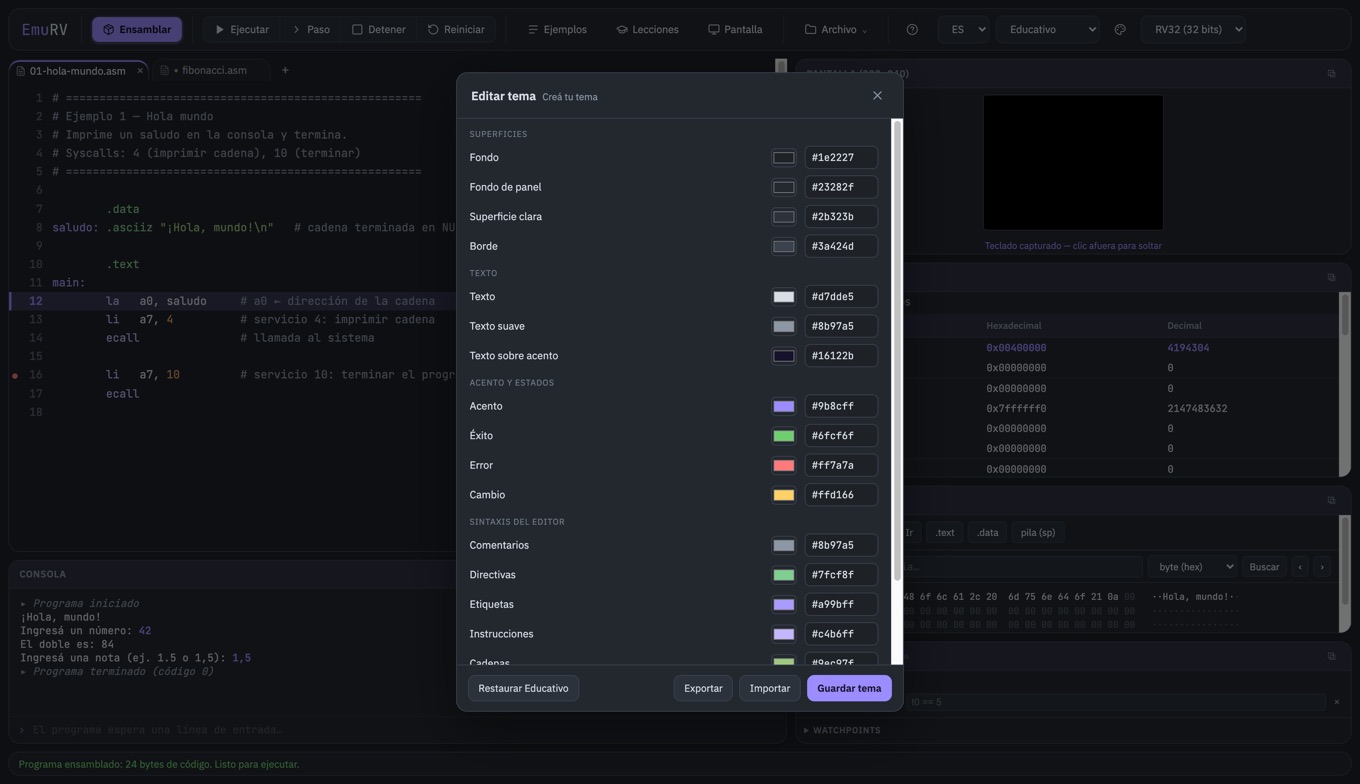
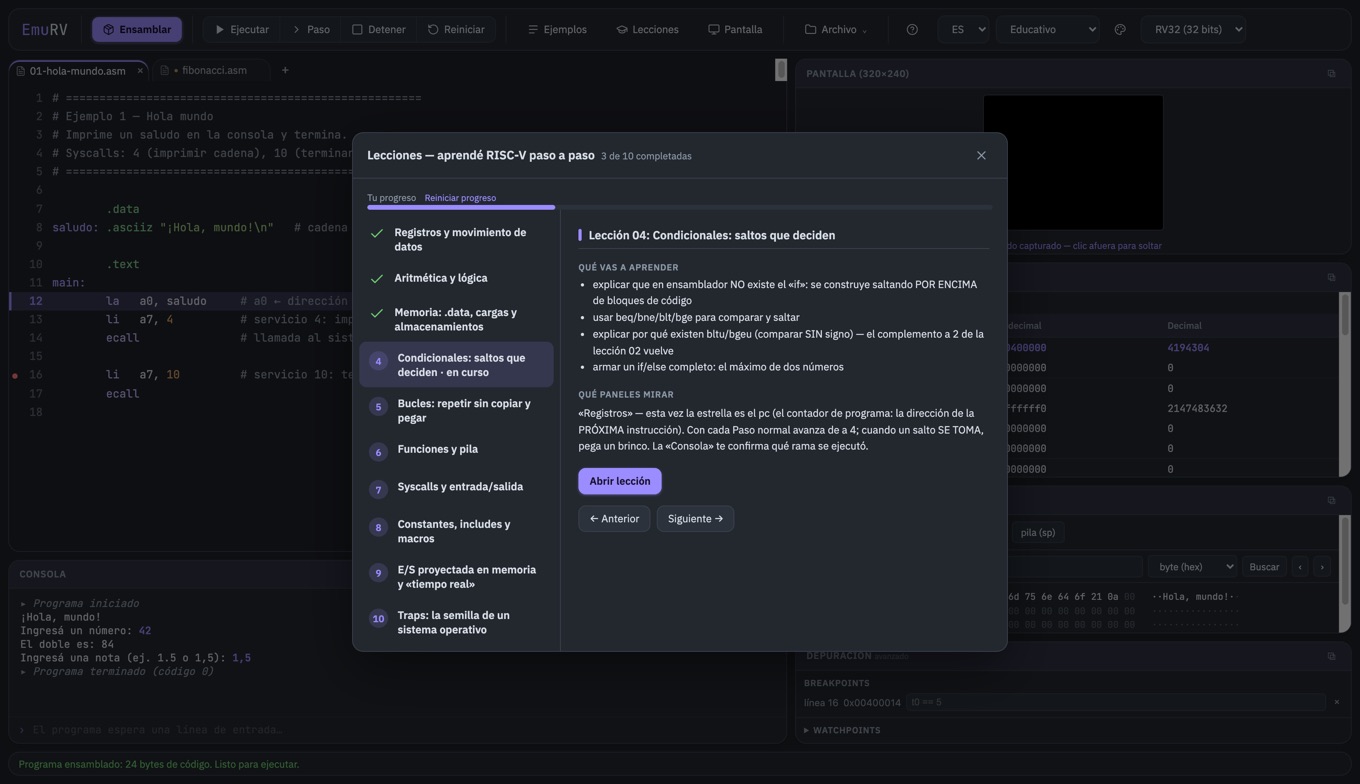
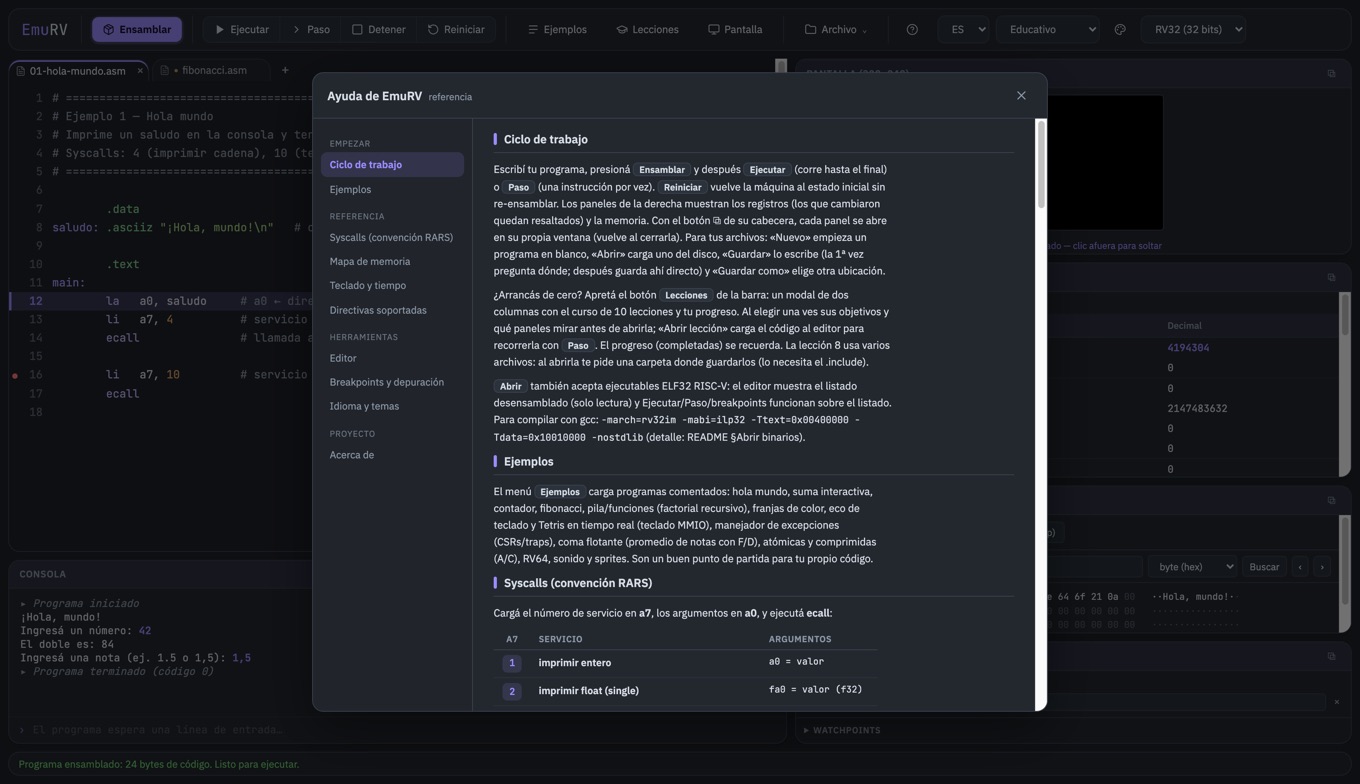
a7 value.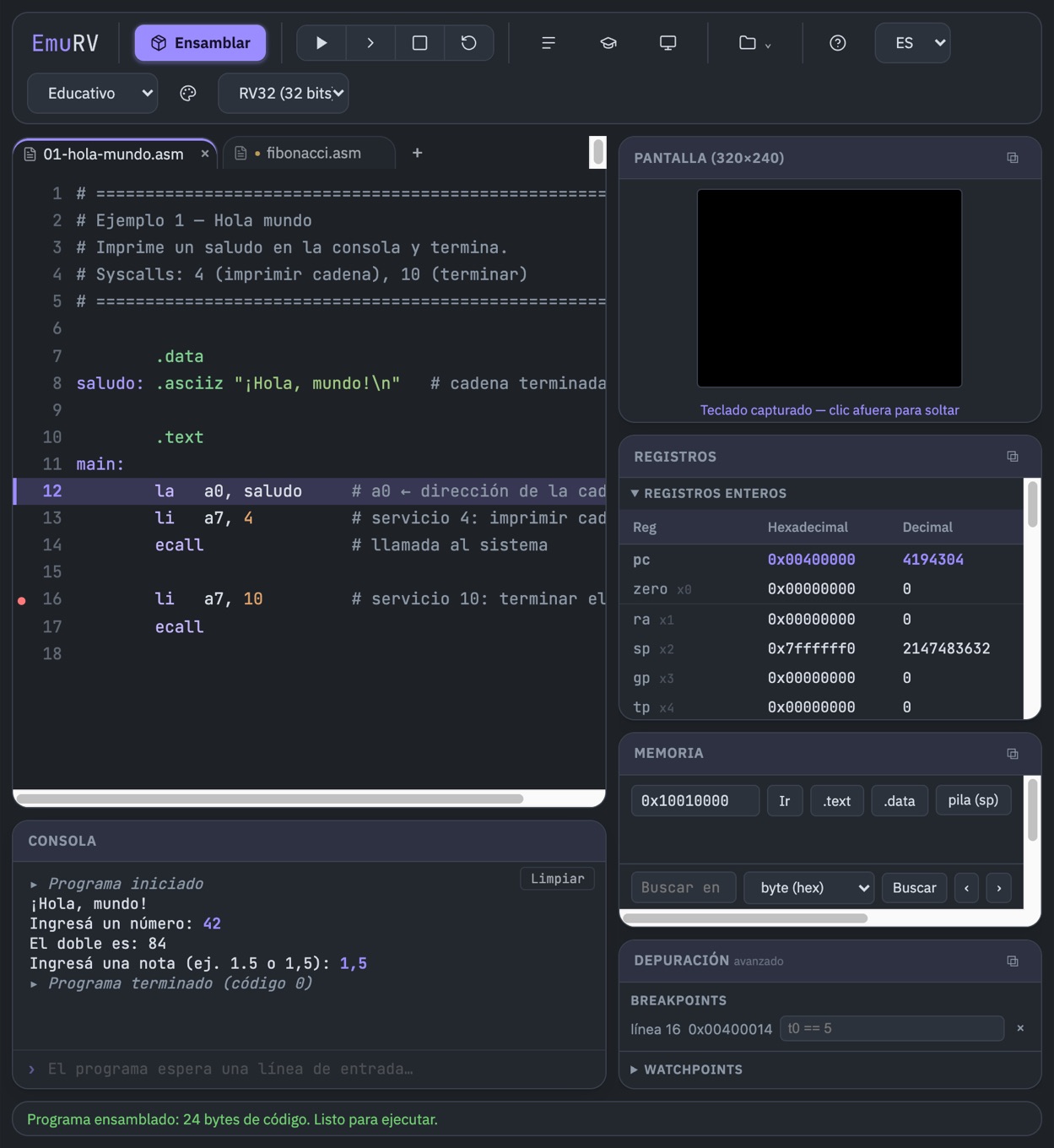
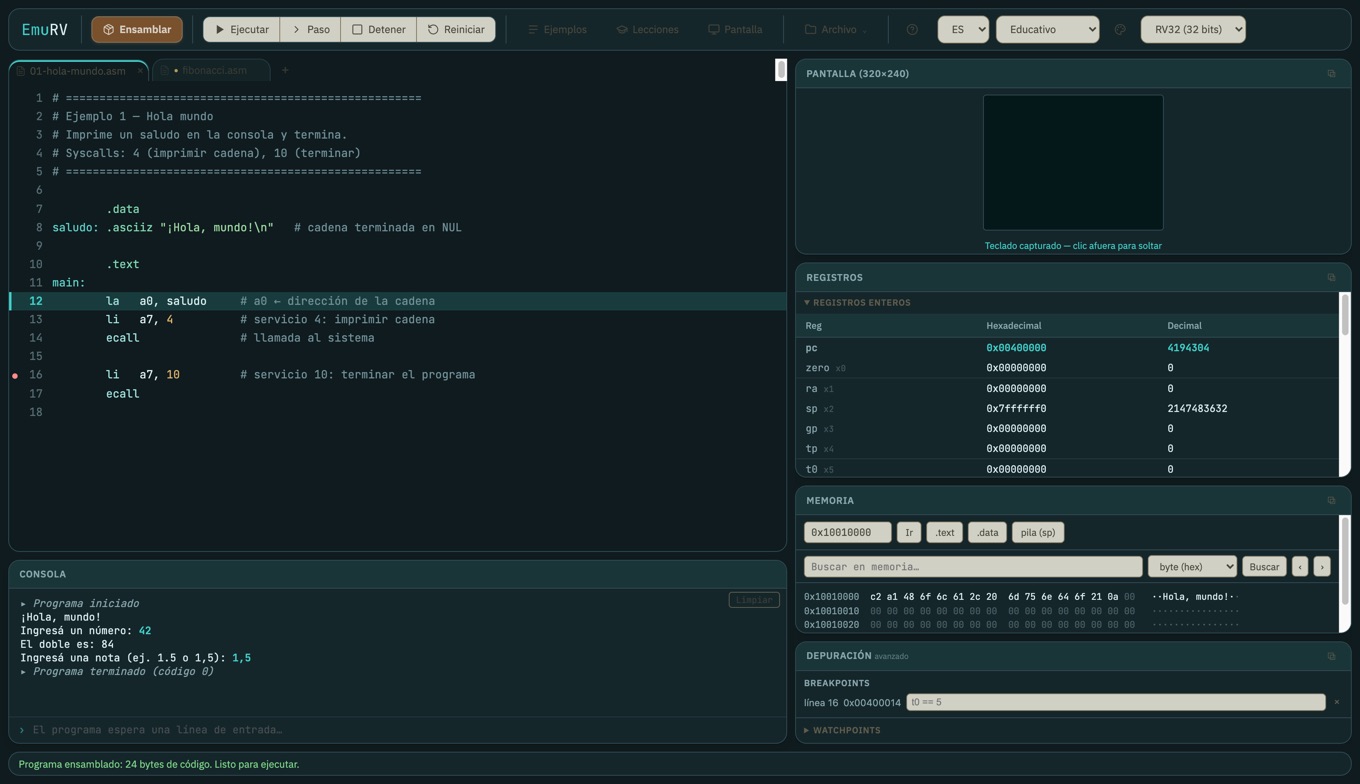
tokens.css: they are CSS variables applied live on :root and saved on the machine.One language decision, stated rather than hidden
The interface has an ES/EN selector. The assembler and runtime diagnostics, and the lesson content, stay in Spanish even in English mode. That is a declared scope decision — the Spanish material is the didactic contribution of the thesis, and translating it would have meant maintaining two versions of the thing being evaluated. It is written down as a decision, not left as an oversight for someone to discover.
09Inventory, and what is still missing
Core
- Rust · Tauri 2
- Unicorn Engine 2.1.5
- Own RV32IMAFDC / RV64IM assembler
- Own disassembler
- ELF32 export and import (crate
object) - Emulation on a dedicated thread
Devices
- Framebuffer VGA 13h · 320×240
- MMIO keyboard, RARS-compatible
- Tone generator (off by default)
- Syscalls in the RARS convention
- Zicsr · user trap handler
Interface
- TypeScript · Vite
- CodeMirror 6 (own RISC-V mode)
- CSS design tokens · 5 themes + user theme
- IBM Plex Sans · JetBrains Mono (self-hosted, OFL)
- Detachable panel windows
- ES / EN with persistence
Tooling
emurv-cli— headless assemble / run / disasm / debug- GDB remote stub (gdbserver protocol)
- Semantic exit codes, for automatic grading
- GitHub Actions · 4 jobs · bundle weight gate
Verification
- 440 automated tests, zero failures
- Encoding oracle against GNU
as - riscv-tests · 78/78 executable
- RISCOF vs Sail · 72/72 signatures
- Automated WCAG AA contrast test
- Reproducible benchmark (script + CSV)
Written record
- 32 roadmap points, each with its plan
- Engineering log with the decisions and their why
- Documentary reconciliation against evidence
Where it really stands
The thesis is in progress. Separating what is verified from what is merely built is the whole point of the exercise.
- · RV32IMAFDC + switchable RV64IM
- · Official compliance, twice over
- · Screen, keyboard, sound, sprites, traps
- · CLI, GDB stub, CI in green
- · Benchmark against QEMU, Spike and RARS
- · 10 lessons and 15 examples, watched by tests
- · Windows: the NSIS installer cross-compiles and runs in CI, but it has never been opened on a real Windows machine — so I do not claim it works
- · Linux: the code is portable and the build leg exists, marked experimental; not validated
- · macOS on Apple Silicon is the only platform I have actually tested
- · The usability study with students — protocol and questionnaires ready; it needs the supervisor's sign-off and participants. It is what the committee actually grades
- · Hardware interrupts: CLINT and PLIC over an engine that does not expose them
- · CoreMark, code signing and notarisation, versioned releases